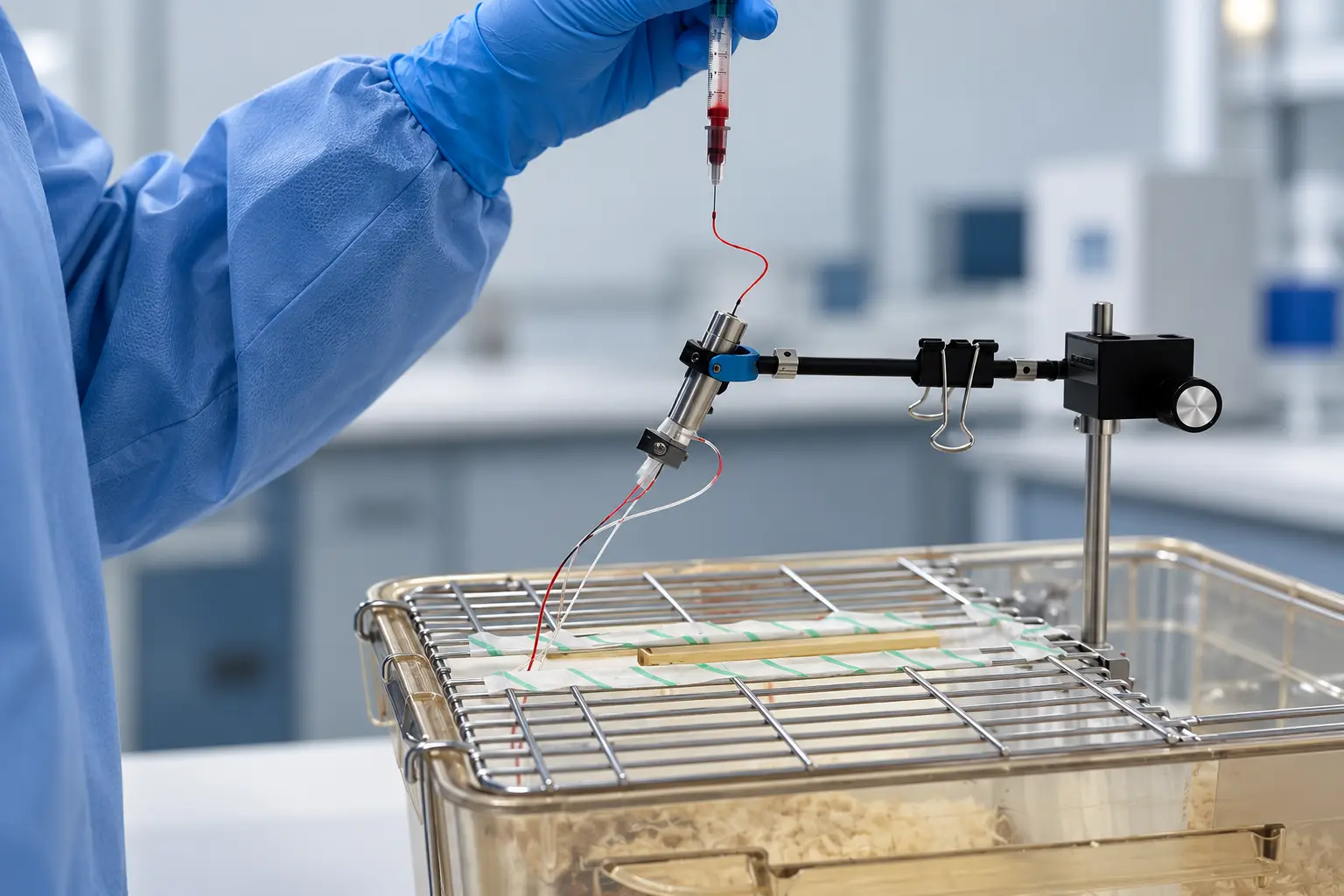
The hyperinsulinaemic euglycaemic clamp is widely regarded as a gold-standard method for assessing insulin sensitivity in mice. Following surgical preparation and recovery, a catheter in the jugular vein is used for infusions and a catheter in the carotid artery enables repeated blood sampling in conscious animals.
Insulin is infused at a controlled rate, while glucose delivery is adjusted to maintain a stable blood glucose concentration. The glucose infusion rate provides a measure of whole-body insulin sensitivity under the agreed experimental conditions.
Isotopic tracers extend these measurements to glucose turnover and tissue-specific glucose uptake. Labelled glucose can help distinguish glucose production from disposal, while labelled 2-deoxyglucose, together with blood and tissue sampling, can quantify uptake into individual tissues. This allows researchers to investigate how insulin action differs between tissues and experimental groups.
- Specialist conscious mouse studies
- Vascular catheterisation and recovery before testing
- Controlled infusions and blood sampling
M.Nixon@ed.ac.uk
What we measure
- Glucose infusion rate needed to maintain the target blood glucose concentration
- Whole body insulin action under the agreed clamp conditions
- Glucose turnover with appropriate tracer protocols
- Tissue glucose uptake with appropriate tracer protocols
Planning your study
Contact the team early to discuss study feasibility, the mouse model, surgical preparation and recovery, insulin exposure and any tracer requirements. The protocol and measurements are agreed for each study.
Read the methodological guidance Study planning and access